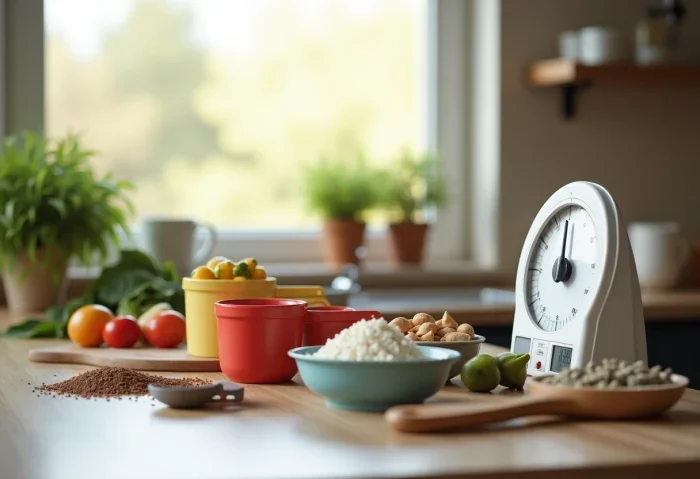
In cooking as in chemistry, precision is fundamental to achieving perfect results. Mastering the conversion of volumes to weights allows for adherence to recipes and protocols. This skill avoids errors and ensures consistent results.
Simple tips exist to facilitate these conversions. For example, knowing the density of ingredients or substances is an essential first step. Using tools such as precise scales and conversion charts can also simplify the process. Adopting these techniques allows for increased efficiency and accuracy, whether it’s to whip up a delicious dish or conduct a scientific experiment.
The Basics of Converting Volumes to Weights in Cooking and Chemistry
Culinary art requires unmatched precision, especially regarding volume conversions. Recipes, whether modern, ancient, or international, often require precise adjustments to ensure their success. The liquid and dry ingredients involved in these recipes demand a perfect mastery of measurement units such as milliliters, centiliters, cups, and fluid ounces.
The density of ingredients plays a crucial role in this process. For example, one liter of water equals 1000 grams, but one liter of flour weighs only about 550 grams. Converting liters to grams requires knowing the specific density of each ingredient. This density directly affects the conversion and must be taken into account to avoid errors that could compromise the final result.
- Liquid ingredients: water, milk, oil
- Dry ingredients: flour, sugar, salt
The metric system, used in most countries, greatly facilitates these conversions. Measuring cups and other measuring tools allow for adherence to the necessary weight-volume equivalences. Converting volumes to weights can also involve using fractions, which sometimes complicates calculations. In mixology, for example, these conversions are essential for creating balanced cocktails.
Precision in converting volumes to weights is essential for successfully executing a variety of recipes, from Margherita pizza to summer cocktails. Knowing the density of ingredients and using the correct measurement units are key steps to ensuring consistent and flavorful results. 
Techniques and Tips for Accurate and Effective Conversions
Precision in converting volumes to weights relies on the use of appropriate tools. Among these are the kitchen scale and measuring cups, essential for accurate measurements. These instruments allow for converting volumes to weights while considering the specifics of each ingredient, whether liquid or dry.
- Kitchen scale: ensures measurement accuracy.
- Measuring cups: guarantee exact measurements for liquids.
To simplify these conversions, using a conversion chart proves particularly useful. It provides a quick and reliable reference for switching from one unit to another, thus avoiding dangerous approximations. Mobile apps dedicated to cooking can also facilitate these operations by offering automated calculations and personalized advice.
Practical Tools and Tips
Beyond traditional measuring tools, measuring spoons play a fundamental role in ensuring consistency in culinary results. They ensure precise quantities for small measurements, often overlooked but equally significant. The experience and intuition of the cook complement this arsenal, helping to adjust measurements according to the specifics of each recipe.
| Tool | Utility |
|---|---|
| Kitchen scale | Ensures measurement accuracy |
| Measuring cups | Exact measurements for liquids |
| Measuring spoons | Precise quantities for small measurements |
The pursuit of precision is therefore paramount to ensure the success of recipes as diverse as Margherita pizza or summer cocktails. Consider these techniques and tools to optimize your conversions and achieve consistent and flavorful results.