A 14-year-old teenager wants to ride a scooter to school as soon as the new term starts. His parents are looking for the quickest solution, typing “BSR online” and coming across dozens of contradictory results. The reality is simple: the practical BSR training must be done in person, but a good portion of the administrative procedures can now be managed from a screen. Here’s how to combine the two to save time.
BSR and AM license: what “online” really means
The BSR corresponds to category AM of the driving license. It allows the driving of a moped (50 cc scooter) or a light quadricycle (small car) from the age of 14. No platform allows the validation of the entire training remotely.
What can be done online is the administrative part: registration on the ANTS portal, sending the digital photo-signature, tracking the file. The theoretical part (ASSR 1 or ASSR 2) takes place at school, not online. The practical part requires a certified instructor and a real vehicle.
However, you can take the BSR online with AXX Auto to simplify all administrative management and speed up the start of training.
The classic trap: confusing “registering online” with “training online.” Driving schools that offer a dematerialized registration do not provide practical training remotely. They facilitate the preparation of the file, which saves several days compared to going to a physical agency.

ASSR, ASR: the theoretical prerequisite before practical training
Before getting on a scooter with an instructor, you must hold the first-level school road safety certificate (ASSR 1) or the second-level certificate (ASSR 2). These certificates are obtained at school, respectively in the 5th and 3rd grades.
For those who are no longer in school (dropouts, recent arrivals in France), the road safety certificate (ASR) replaces the ASSR. It is prepared at a GRETA or an accredited training center.
- ASSR 1: accessible from the 5th grade, sufficient to start BSR training at 14
- ASSR 2: taken in the 3rd grade, also validates the theoretical prerequisite for the BSR
- ASR: alternative for those not in school, same road safety content, organized by municipalities or GRETA
Without one of these certificates, no driving school can legally start practical training. This is the first document to check before registering anywhere.
Practical training for the AM license: actual process on the ground
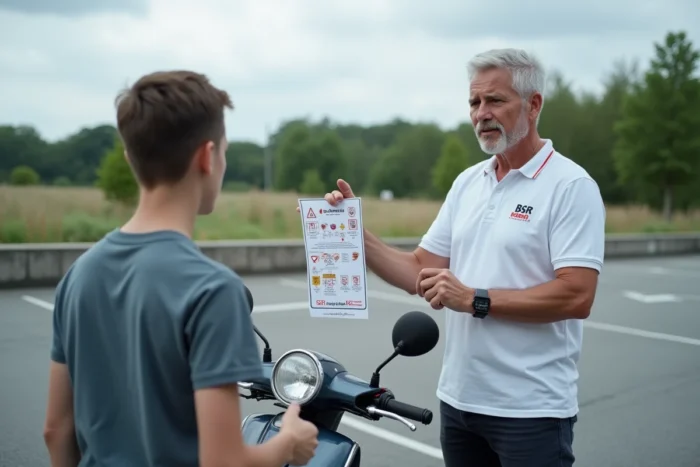
The training lasts a minimum of two days. It consists of classroom sessions and road driving sessions, supervised by a certified instructor at a driving school.
What we do during the sessions
The training alternates between applied theory (risk awareness, behavior in traffic) and practice on a moped or light quadricycle. You learn positioning on the road, emergency braking, intersections, and speed management in urban areas.
The training is not an exam: there is no grade or final test. The instructor validates the skills acquired and issues a training certificate. It is this certificate that then allows you to apply for the AM license on the ANTS portal.
Mandatory equipment on the day of training
The candidate must present with an approved helmet, CE-certified gloves, a jacket covering the arms, and sturdy shoes. The driving school can refuse a student whose equipment does not meet these criteria, which delays the training.
It is recommended to check this point at the time of registration. Some driving schools lend helmets and gloves, while others do not. Feedback on this point varies by establishment, so it’s best to ask the question directly.
Driving license B at 17 and BSR at 14: deciding between the two
As of January 1, 2024, the age for independent driving for the B license is lowered to 17. This change alters the situation for families who are hesitating between starting a BSR early or waiting for the B license.
For a young person aged 14 or 15, the BSR remains the only legal means to ride a scooter or small car. The calculation is different for a 16-year-old: they can start accompanied driving for the B license and obtain their license at 17, which also covers the driving of mopeds.
The BSR becomes a mobility gateway for 14-16 year-olds, not an end in itself. Beyond 16, it is often better to invest directly in the B license, especially if the family budget is limited.
Cost of the BSR and often overlooked financial aid
The price of training varies from one driving school to another and from one city to another. Before comparing, check one crucial point: the driving school must be labeled “quality of training within driving schools” to open access to certain public schemes.
Several Regions and Departments offer financial aid for young people, including for category AM. These schemes have various names (mobility vouchers, driving aid) and generally target those aged 16-25. They are not reserved for the B license.
- Check on your Region or Department’s website for available mobility aids
- Confirm that the chosen driving school has the required quality label
- Inquire with the local mission for young people in integration
These local aids significantly reduce the remaining costs, but they require choosing a labeled establishment. A driving school that appears cheaper on paper but is not labeled may ultimately cost more if it closes access to funding.
The BSR remains a short training course, accessible from the age of 14, with an increasingly digitalized administrative part. The main point of vigilance is not the training itself, but the choice of driving school: quality label, equipment provided or not, possibility of regional aids. This is where the difference between a smooth process and a journey fraught with setbacks is made.