Cooking can sometimes seem intimidating, especially when it comes to understanding measurement conversions. Imagine following an American recipe that uses cups, while your kitchen scale only measures in grams. For beginners, mastering these conversions is essential for successfully preparing all kinds of dishes.
Knowing how to convert measurement units can transform your cooking experience. For example, a tablespoon is equivalent to about 15 milliliters, while a cup contains about 240 milliliters. These little tips simplify recipe preparation and allow you to cook with more confidence and precision.
Essential Measurement Units in Cooking
Understanding measurement units in cooking is essential for any novice looking to get into the culinary arts. Cup measurements are commonly used in American recipes, but they can be confusing for those using the metric system.
Conversion Between Cups and Grams
It’s important to know how to convert cup measurements into grams for optimal accuracy, especially in baking. For example:
- One cup of flour generally equals about 136 grams.
- One cup of sugar weighs about 120 grams.
- One cup of butter has a mass of about 227 grams.
Conversion of Liquids
Liquids also require precise conversions. One cup of liquid, like milk, generally equals 240 milliliters. For smaller quantities, note that 20 cl in ml corresponds to 200 milliliters.
| Unit | Equivalence |
|---|---|
| 1 tablespoon | 15 milliliters |
| 1 cup | 240 milliliters |
| 1 liter | 1000 milliliters |
Weight and Volume of Dry Ingredients
Conversions between weight and volume are essential for dry ingredients like flour and sugar. Both volume and weight must be mastered to ensure the success of recipes.
Precision in measurements is particularly fundamental in baking, where even the slightest deviation can alter the texture and taste of a cake. Use reliable measuring tools and carefully follow recipe instructions for optimal results.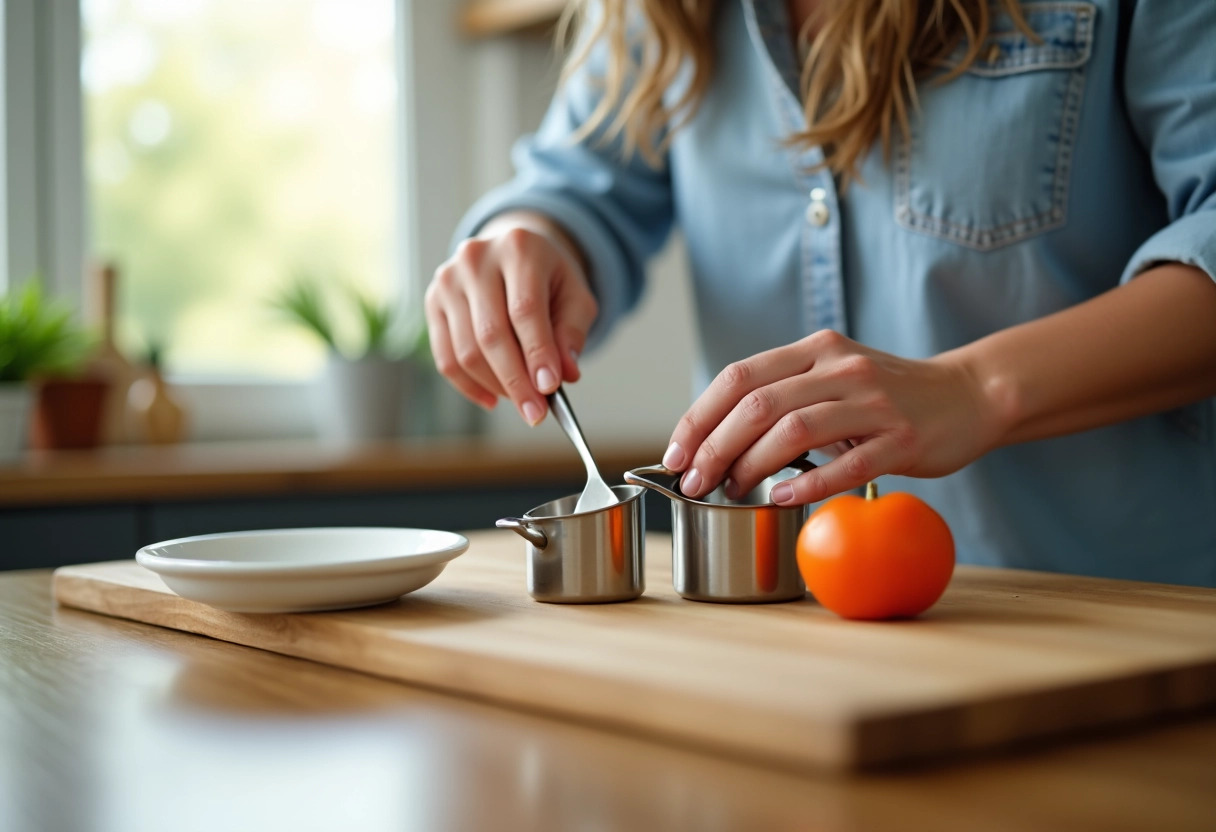
Techniques and Tips for Easily Converting Measurements
Mastering conversions in cooking requires the right tools and techniques. Using a kitchen scale remains the most accurate method for converting quantities. A scale allows you to measure to the nearest gram, thus eliminating the approximations that often lead to errors in baking.
For small quantities, measuring spoons are essential. A tablespoon of flour equals 10 to 12 grams, while a tablespoon of sugar weighs between 12 and 15 grams. These simple tools ensure the accuracy essential for achieving optimal textures and flavors.
Conversion charts are also valuable allies. They provide quick and reliable equivalences between different measurement units. For example, to convert milliliters to centiliters, simply divide by 10. A tablespoon contains 15 milliliters, which corresponds to 1.5 centiliters.
Online calculators offer a modern and convenient alternative. With just a few clicks, they allow you to convert complex measurements without the risk of error. These tools are particularly useful for conversions between the metric system and Anglo-Saxon units.
A combination of kitchen scale, measuring spoons, and conversion charts ensures precise and reliable results. These tools, combined with an understanding of the basics of conversion, allow you to approach any recipe with confidence, even the most technical ones. The most accurate method for conversion is to use a kitchen scale, a statement that continues to be validated through culinary experiences.