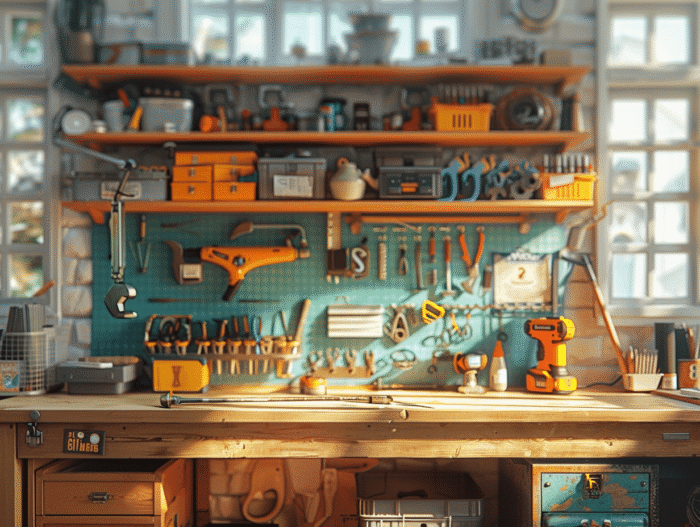
At the heart of every home lies a toolbox, filled with icons that tell a rich story of creativity and ingenuity. The symbols of the DIY world, such as the hammer, screwdriver, or drill, are much more than mere tools; they reflect a cultural and technical evolution. These familiar objects have shaped generations of builders and innovators, embodying the very essence of transformation and repair. Behind every handle, every blade, or every bit, lies a captivating narrative of discoveries, inventions, and the relentless human quest to improve one’s immediate environment.
The Origins and Evolution of DIY Symbols
The history of DIY symbols, these pictograms that are ubiquitous in our assembly instructions and hardware stores, such as the Leroy Merlin logos, has roots in an ancestral past. Visual communication dates back to the Lascaux Cave, where early humans already expressed their daily lives and aspirations through pictorial signs. Consider these murals as the distant ancestors of our modern icons.
The Rosetta Stone, for its part, played a key role in deciphering Egyptian hieroglyphs, demonstrating that humanity has always sought to condense information into symbols. The early 20th century saw the birth of international road signage, adopting pictograms that are now universal, designed to transcend linguistic and cultural barriers, proving the power of the image over text.
In this vein, the work of Otto Neurath and his Isotype system marked a decisive turning point in the development of pictograms capable of translating complex ideas into a simple graphic form understandable by all. Herbert W. Kapitzki also contributed to the conceptualization of the pictogram as an iconographic sign, a universal language for the modern era.
Over the centuries, the evolution of these symbols has been shaped by the ever-changing needs of society. Architects and designers like Otl Aicher and Herbert W. Kapitzki forged a visual aesthetic that permeates our culture and architecture to this day. Their works have inspired continuous innovation in the art and design of symbols, proving that DIY and its visual representations constitute a rich and fascinating history, intimately linked to the development of our civilization.

Impact and Representation of DIY Symbols in Popular Culture
The role of DIY symbols extends far beyond the confines of workshops and instruction manuals. In popular culture, their presence is as discreet as it is essential, creating a visual language that is accessible to all. Take the Olympic Games: since Otl Aicher created a pictogram language for the sporting event, these signs have contributed to better orientation and understanding of the disciplines by the general public, uniting spectators around instantly recognizable visual representations.
Airports, those crossroads of globalization, are another example where the use of pictograms proves fundamental. Visual systems, like the one designed by Intégral Ruedi Baur Paris for Cologne-Bonn Airport, facilitate traveler navigation, regardless of their origin or spoken language. These symbols guide, inform, and reassure, functioning as universal beacons in the relentless flow of international mobility.
Design agencies, such as Sagmeister & Walsh or DixonBaxi, have embraced the expressive potential of pictograms to create striking visual identities. The graphic creations of DixonBaxi for Eurosport or the mechanical identity of Function Engineering by Sagmeister & Walsh show how these symbols can be adapted to convey specific messages and strengthen a company’s brand.
The link between pictograms and architecture is perfectly illustrated in the Pentagram Design project for the Amorepacific headquarters in Seoul. The agency harmonized these signs with architecture and typography, demonstrating that DIY symbols can be sustainably integrated into the aesthetic of a space, contributing to its identity and the experience of its users. These examples illustrate the ability of pictograms to leave an indelible mark on collective memory, beyond their primary function as facilitators of manual tasks.