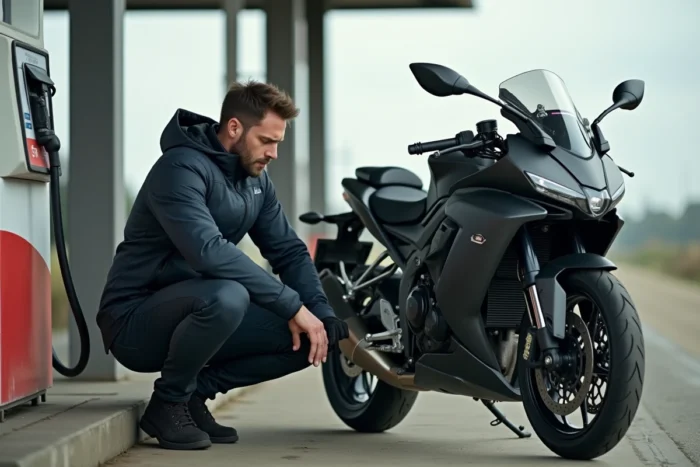
Before going on a road trip or simply to manage daily refuels, the size of a motorcycle’s tank radically changes the riding experience. A tank that is too small requires frequent stops. An oversized tank adds weight to the machine and alters its behavior. Understanding the capacity of the motorcycle tank allows for choosing a model suited to its actual use.
Motorcycle Tank and Euro 5 Standards: What Has Changed Since 2021
You may have noticed that recent technical sheets display slightly larger tanks on certain trails and roadsters? This is no coincidence. Since the implementation of Euro 5 and then Euro 5+ standards (between 2021 and 2024), pollution control systems have become more complex. This technical complexity sometimes leads to a slightly higher fuel consumption.
To compensate, several manufacturers have increased the tank volume on their medium and large displacement models. The goal: to maintain a real range of at least 300 km on motorcycles intended for travel, despite engines that consume more to meet emission thresholds.
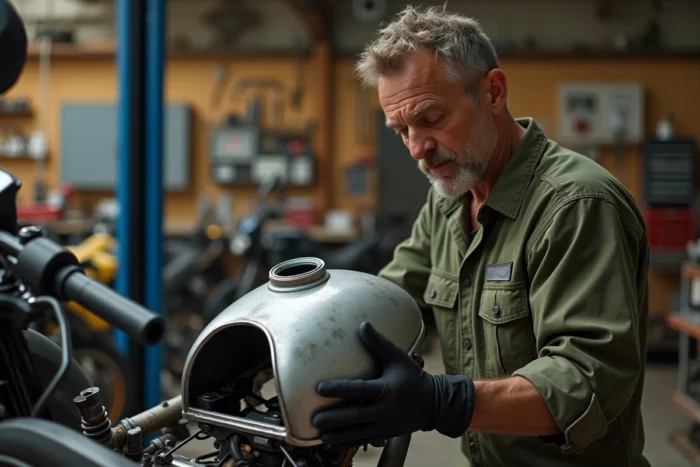
Conversely, cross and enduro motorcycles follow an opposite logic. Here, weight takes precedence. Tanks are often limited to 6 to 8 liters to centralize mass and keep the motorcycle agile. Manufacturers offer long-range tanks as an option through their racing catalog, rather than inflating the original capacity.
To better understand the average capacity of motorcycle tanks according to categories, it is essential to clearly distinguish the intended use by the manufacturer.
Tank Capacity According to Motorcycle Type: Concrete Guidelines
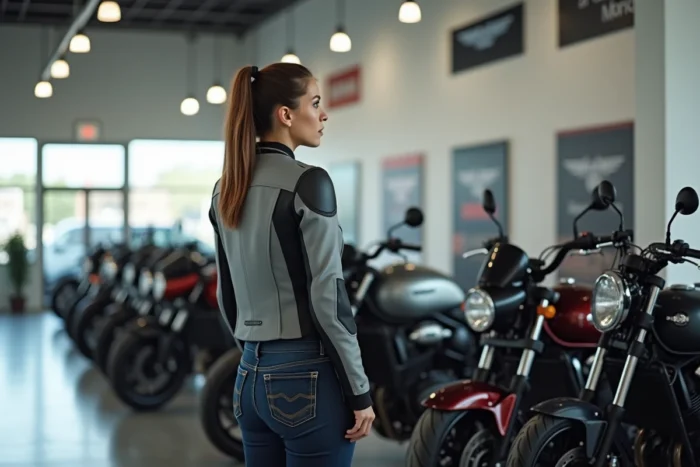
Not all motorcycles are designed for the same distance between two gas stations. The differences in capacity can be explained by the vehicle’s category, its displacement, and its purpose.
Small Displacements and A2 Motorcycles
The reform of the motorcycle license in France, with the mandatory transition to the A2 license, has pushed manufacturers to multiply models that can be restricted between 300 and 500 cm³. These machines typically feature tanks of 14 to 17 liters. This volume offers a range comparable to that of older large displacements while remaining within an accessible size.
Trails and Touring Motorcycles
Medium and large displacement trails often exceed 18 liters. Some grand touring models reach or exceed 20 liters. The idea is simple: to ride for a long time without stopping. On a loaded trail with luggage and a passenger, fuel consumption increases, and a generous tank compensates for this reality.
Sport Motorcycles
Sport bikes willingly sacrifice a few liters of capacity for the sake of compactness and center of gravity. A smaller tank keeps the mass centered, which improves handling in turns. Most hover around 15 to 17 liters, sometimes less on track-oriented models.
Auxiliary Tank on Motorcycle: Insurance and Homologation
Adding an auxiliary tank to gain autonomy seems logical, especially for long-distance travelers. This modification is not trivial from a legal and insurance standpoint.
Since 2023, some insurers in France explicitly include in their general conditions that non-homologated additional tanks may lead to a loss of coverage. In the event of a fire or accident, an undeclared homemade tank is enough to void the coverage.
Before modifying your motorcycle, check two points:
- The auxiliary tank must be homologated for road use, with certification compliant with the regulations in your country.
- Your insurer must be informed in writing of the modification, ideally before installation, to avoid any subsequent disputes.
- On enduro models, long-range tanks offered directly by the manufacturer are generally covered without additional steps.
This point is often overlooked by motorcyclists who tinker with their machines. The financial consequence in the event of a claim can be significant.
Choosing Your Motorcycle Based on Tank Capacity: Practical Criteria
Raw capacity in liters is not enough. What matters is the real range, which depends on the combination of tank volume and engine consumption.
Why is this choice more subtle than it seems? A motorcycle with a 20-liter tank that consumes 7 liters per 100 km offers barely 280 km of range. Another with 15 liters but a consumption of 3.5 liters per 100 km exceeds 400 km. The capacity/consumption ratio takes precedence over volume alone.
Here are the questions to ask before purchasing:
- What is your primary use: short daily commutes, sporty weekends, long-distance travel?
- What is the density of gas stations along your usual routes? In rural areas or mountains, a larger tank is reassuring.
- Are you willing to accept extra weight from a larger full tank, or do you prefer a lighter machine even if it means refueling more often?
- Does the targeted model offer extended range options (optional tank, economical engine mapping)?
For mixed city-highway use, a tank of 14 to 17 liters covers most needs. Regular travelers will benefit from aiming for 18 liters and above, ensuring that the stated consumption remains consistent with their actual driving conditions.
The choice of tank is not a secondary technical detail. It is a parameter that conditions daily comfort of use, the frequency of stops, and, on long journeys, the ability to enjoy the road rather than monitor the fuel gauge.