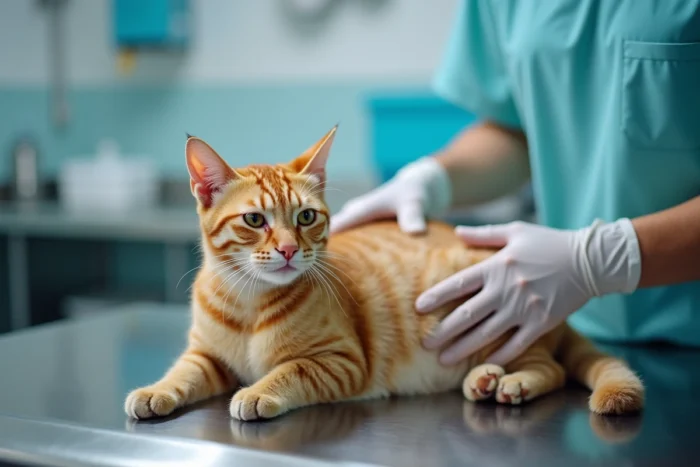
A distended abdomen in cats is never a sign to be taken lightly. Behind a swollen belly lie various pathophysiological mechanisms, from simple functional ileus to massive peritoneal effusion. Distinguishing gas distension from fluid accumulation directly guides the diagnostic approach and conditions the prognosis.
Abdominal palpation in cats: what the consistency of the belly reveals
Palpation remains the first discriminating tool. A tense, non-depressible abdomen will suggest fluid accumulation (ascites, effusion related to feline infectious peritonitis) or a mass occupying space. A soft, tympanic belly upon percussion is more indicative of gas distension related to a transit disorder or aerophagia.
In practice, we observe that many owners confuse an overweight cat with one that has a swollen belly. The difference is palpable: the ventral adipose tissue (the “fat apron”) remains mobile and soft, whereas pathological distension alters the silhouette symmetrically or asymmetrically and is often accompanied by discomfort upon handling.
An underestimated point: the speed of swelling onset guides the diagnosis. A distension that develops within a few hours indicates an emergency (torsion, internal bleeding, obstruction). A gradual swelling over several weeks points to a chronic cause (massive parasitism, abdominal tumor, right heart failure with secondary ascites). To better understand the causes of a swollen belly in cats, this timeline of onset serves as a reliable clinical marker.

Feline infectious peritonitis and GS-441524 antivirals: where do we really stand?
Wet FIP remains one of the most feared causes of abdominal distension. The effusion is typically a straw-colored, viscous fluid rich in proteins. For decades, the diagnosis equated to a death sentence.
GS-441524 antivirals radically change the prognosis. Survival rates significantly higher than those of previous palliative care are now documented. These molecules are being used in an increasing number of clinics across Europe, including France.
The issue remains regulatory. These medications do not have marketing authorization in several EU countries, creating significant disparities in access between veterinary facilities. A university hospital or a specialized referral center will have easier access than a rural general practice clinic. We recommend that owners faced with a diagnosis of wet FIP explicitly ask their veterinarian if an antiviral protocol is feasible, even if it means being referred to an equipped facility.
Intestinal parasites and abdominal distension in kittens
In kittens, a hard swollen belly with a thin body condition is an almost pathognomonic picture of massive parasitic infestation. Roundworms (Toxocara cati) are the main culprits. Contamination occurs transplacentally, through maternal milk, or by ingesting paratenic hosts.
More than one-third of cats in France are believed to carry intestinal parasites. This figure alone justifies a rigorous deworming protocol starting in the first weeks of life. A kitten that has not been dewormed before adoption is at high risk of abdominal distension, diarrhea, and growth delay.
- Deworming starting at two weeks of age, then every two weeks until weaning, and monthly until six months
- Control coproscopy if symptoms persist despite proper treatment, to identify resistant or atypical parasites (Giardia, coccidia)
- Simultaneous treatment of all household animals to prevent cross-contamination
Digestive obstruction and foreign bodies: the trap of late diagnosis
Linear foreign bodies (strings, rubber bands, threads) pose a specific danger to cats. The string attaches to the base of the tongue or the pylorus, and intestinal peristalsis causes the small intestine to fold like an accordion. This mechanism can lead to intestinal perforation in less than 48 hours.
Standard radiography is not always sufficient. A radiolucent foreign body may go unnoticed on a simple X-ray. Abdominal ultrasound, and in some centers, diagnostic assistance through artificial intelligence applied to imaging, improve early detection of these obstructions. The BSAVA 2024 congress even dedicated a session to the use of AI for interpreting abdominal imaging, with promising results on detecting ascites, masses, and foreign bodies.
Associated signs to monitor:
- Repeated and unproductive vomiting, especially if the cat has access to strings or string toys
- Complete cessation of transit (no stools for more than 24 hours associated with vomiting)
- Marked abdominal pain upon palpation, hunched posture, refusal to move
- Hyperthermia or, conversely, hypothermia in case of starting septic shock
Diet and chronic abdominal swelling in adult cats
Moderate but recurrent abdominal distension in an adult cat often points to a dietary issue. Diets too high in carbohydrates promote colonic fermentation and gas production. Poor quality kibble, high in grains, are frequently to blame.
A sudden dietary transition is another underestimated factor. The feline intestinal microbiota takes several days to adapt to a new nutritional substrate. We recommend a gradual transition over a minimum of seven to ten days, mixing the old and new food in stages.
Chronic constipation, common in sedentary and insufficiently hydrated cats, also causes palpable distension of the colon. Switching from an exclusively dry diet to a mixed ration incorporating wet food significantly improves transit in most cases.
A swollen belly in a cat always warrants a veterinary evaluation, even when the overall condition seems stable. The therapeutic window for certain causes (obstruction, FIP, torsion) is measured in hours. Better a false alarm than a diagnosis made too late.